Hip-Gnosis Seed Development Research Notes (2007/2008)
Written By: Alan Reed Bishop
Two Year Pedigree of Astronomy Domine Sweet Corn: Notes on parent lines in original two mass crosses as well as selection criteria and explanation of intent and novelty.
Explanation and Intent of development:
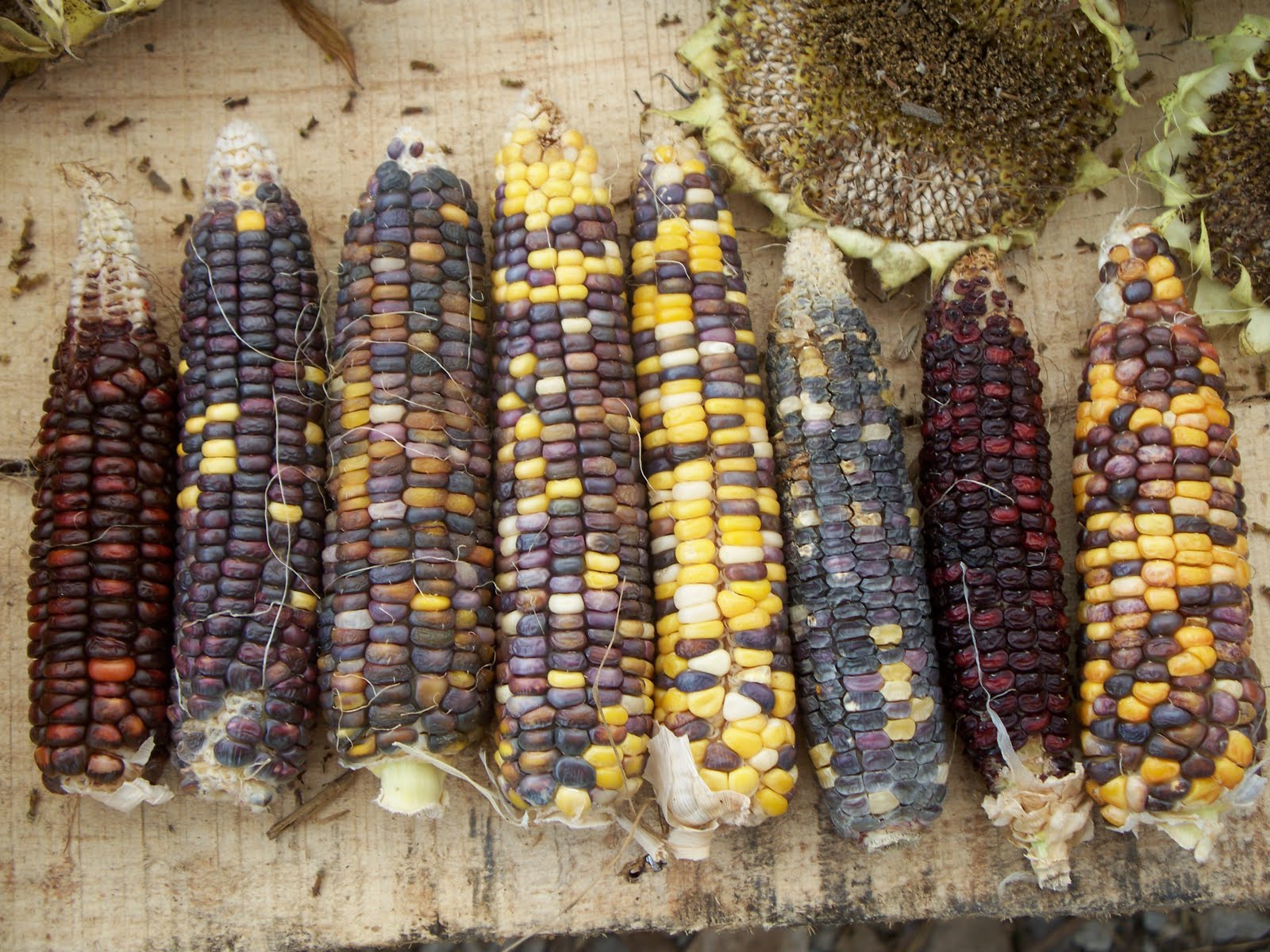
Astronomy Domine Sweet Corn is the working name of a “mass cross” breeding and selection for sweet corn which meets a niche demand in Southern Indiana markets for a multi-colored, open pollinated, enhanced nutrition, drought tolerant and genetically diverse sweet corn of special interest to home gardeners, seed savers, and market gardeners looking to fill a niche. The project has evolved over the past year by way of the Hip-Gnosis Seed Development Project to include and inspire home gardeners and plant breeders across the United States and Canada to use the first generational germless from the original mass cross to develop and increase the diversity of regional strains of Astronomy Domine which may later be renamed by participating growers to their own desire.
Multiple lines of colored open pollinated and hybrid sweet corns were planted together in a small eight row block on our small produce farm in Pekin Indiana in the 2007 season. The corns ranged days of maturity from 55-90 days, planting was staggered so as to further facilitate crossing between late maturing, mid maturing, and early maturing varieties leading to a harvest date that was literally all over the map in the late summer and early fall of 2007. No irrigation was performed and the plot was fertilized only with composted chicken manure. Very little earworm damage was noticed and the corn seemed mostly unfazed by the record setting drought of 2007, sans the genetics provided by Ruby Queen hybrid sweet corn (Burpee’s Seeds). CCorn planted early in the season (as early as April 23’d) was somewhat affected by the cool soil emergence; however this provided us with a bit of selection for cool soil emergence issues. Seed was interplanted in bare spots over the next three weeks to further facilitate the crossing of different maturing dates.
Colored corn kernels are of particular interest to us in our breeding experiments due to the high levels of Anthocyanins which free radical scavenging amino acids are thought to be important in both combating and preventing cancers.
This corn also represents progress towards a self sustainable, Open Pollinated sweet corn developed for organic and natural growing systems as well as selected for multiple uses. Fresh Culinary, Dried or made into corn meal, and ornamental uses. Also represents an attempt at developing a “Value Added Seed” line with the added value present in the free amino acids that pericap color imparts. This experiment also represents an attempt at developing defined color traits in the early milk stage of sweet corn for the purpose of attracting market customers and for the added nutrition of the pigmentations of these corn kernels.
Note:
“Value Added Seed” - Is a term that I use to describe seed of special interest which contain added traits which set them apart from standard varieties. Particularly traits which make the seed novel and in most cases higher in nutrition than alternative seed.
Pedigree:
The following is a listing of the corns included in the original mass cross of 2007 as well as some descriptive notes regarding each variety:
Ruby Queen Hybrid- Sugar Enhanced deep red kernelled hybrid variety introduced by Burpee. Tolerant of Rust and Stewarts Wilt. Not cool soil tolerant but a good source of color and anthocyanins. Color apparent at milk stage.
Blue Jade-Open Pollinated SU variety sourced through www.seedsavers.org . Very diminutive and dwarf variety that is actually acceptable for pot cultures. Short season, developed in the north. Deep blue kernels at maturity, increasing in color as the conversion of starch progresses. Apparently somewhat drought tolerant. Planted throughout the three week period. Color apparent at late milk/early starch stage
Millersburg Red Sweet Corn- Open Pollinated SU variety that was sourced locally in neighboring Orange County Indiana. Large Kernelled late season variety, not as deep red as ruby queen, more subdued earth tone and diluted red color. Large Ears and Tall plants. Color apparent at late milk stage
Millersburg small- Open Pollinated SU Variety, sourced from the same location as above but smaller diminutive plants that mature early, probably the result of inbreeding depression. NEarly identical to above variety. Color apparent at late milk stage
Red 101-Open Pollinated SU variety, sourced from Purdue University. No history was reported other than a possible breeding line from a “corn lab” once located in Clark County Indiana. Late season, large eared and kernelled, deep red cultivars. Tolerant of Stewarts Wilt, cold tolerant seed. Three ears to a stalk. Color apparent at milk stage.
Mushrooms Martian Double Red Sweet Corn- Open Pollinated SU Variety. Sourced through Sow Organic Seed. Bred by Dr. Alan Kapuler of peace seeds. Purple kernelled mid-season type, high in anthocyanins (reportedly higher than that of blueberries), mid to late season. Pedigree includes “True Platinum”. Color apparent at milk stage
Triple Play- Open Pollinated SU variety from Seeds of Change. Could not locate a history or a breeder. Small plants bear three small ears of SU type corn which matures to shades of blue, yellow, and white. Color apparent at late milk stage
Black Mexican- Open Pollinated SU Variety. Reportedly grown in the New York area by Native Americans, primitive and early form of sweet corn. Small plants which produce ears which turn from white to deep blue. Not nearly as sweet as modern varieties even SU types. Color apparent at starch stage
Black Puckers-Open Pollinated SU Variety. Sourced from a seed trade. Nearly identical to Black Mexican with slightly different shaped kernels and some crossing with a red variety. No History Provided. Color apparent at starch stage
Country Gentleman-Open Pollinated SU Variety. Sourced from www.seedsavers.org . Old fashioned white sweet corn. Late maturing, large kernelled and large eared corn, popular with home gardeners. Apparently a parent of popular SU and SE hybrids Silver Queen and Silver King
White 101- Open Pollinated SU Variety. Sourced through Purdue University. Large plants, very late season, near last to mature. Large ears and huge kernels. Makes a good roasting corn but not so good boiled.
Hopi-Pink Sweet Strain- Open Pollinated SU Variety sourced through a trade. A sweet version of the Hopi-Pink flour corn popular among seed traders and corn collectors. Appeared to suffer some amount of inbreeding depression. Beautiful Pink Kernels of sweet corn. Mid Season type. Color apparent at milk stage.
Hookers Sweet- SU, Open Pollinated type. Grown By Ira Hooker and offered by Seeds of Change. White/yellow kernelled sweet corn of good quality, great for roasting. Color is apparent at late milk stage.
Howling Mob- SU, Open Pollinated type. Old fashioned roasting corn, sweeter than most old roasting ears. Late season, large ears, large kernels. Tolerant of Stewarts wilt.
Black?-SU, Open Pollinated type. Very early season. Sourced locally from a farm stand customer. No history given other than grown in the family for years. Appears to differ from other black types. Color apparent at late milk stage.
Double Standard- SU, Open Pollinated bi-color type. Sourced from abundant life seed foundation. Could find no history or pedigree or breeder.
Washington County Orange- SU, Open Pollinated type. Gifted to me by an elderly farming couple years ago. Apparently a selection of a mutant field corn plant from back in the 50’s. Grown for generations by the same family. Mid-Season. Yellow Kernels turn orange-ish red at late milk stage.
Silver King- SE, Hybrid Type. Great tasting and high yielding modern white hybrid.
Golden Bantam- SU, Open Pollinated type. Popular with home gardeners, originally introduced by Burpee’s Seeds man. Plump golden kernels. Mid season type.
Ashworth- SU, Open Pollinated type. Early season sweet corn developed by Fred Ashworth originally supposedly named “rat selected”. Great early season type.
Pastel Colors-SU, Open Pollinated type. Gifted to me by an Appalachian friend in Manchester KY, represents work with segregating crosses of flint types and sweet types. Mixed seed stock from various selections. Late season, large ear types. Colors present in milk stage.
Festival Multicolor-SE/SU types. Developed by Ken Ettlinger of The Long Island Seed Project.
Four other unnamed segregates were also massed into the field. These segregates represented my earliest attempts at sweet corn breeding and were comprised of various crosses of the above.
I feel that it is important for the reader to know that each of the varieties listed above in the cross are also being maintained in their pure state in our living seed bank at Hip-Gnosis Seed Development to preserve their cultural heritage and genetic diversity. Some are being further refined for possible future release. Of particular interest is the Pastel Color line for further development and release.
Seed was selected from the most productive, drought tolerant, healthy, and interesting plants and bulked together for distribution and planting in 2008.
Several new seed stocks have since been added to the mix to further integrate positive traits which we will begin selecting for after this seasons new mass cross. The seed stocks added to the mix include:
Rainbow Inca-SU, Open Pollinated Type. Developed by Dr. Alan Kapular from a mix of southwestern and heirloom sweet corns as well as a large eared, white Chokelo variety from Peru.
Painted Hills-SU, Open Pollinated Type. Developed by Dr. Alan Kapular from a cross of breeder Dave Christianson’s flint corn “Painted Mountain” crossed to Ashworth. Nice diversity of colors, very genetically diverse, large kernelled type.
Cocopah-SU, Open Pollinated Type. Obtained from Native Seeds/SEARCH. A southwestern Native American variety of primitive sweet corn in a wide rainbow of colors.
Future Development:
This year we will have two selections of Astronomy Domine that we will work with. The first will be the original stock with the added genetics mentioned above in a new mass cross. The selection criteria will as always range a wide array of positive traits including cool soil germination and emergence, tolerance to disease, lodging resistance, drought tolerance, and taste, coloration in milk stage, pest tolerance, and taste.
This corn could be widely selected and allowed to re-hybridize every season or diverse selections could be made and selected for uniformity. The idea here is to basically develop an excellent open pollinated corn for organic systems which also incorporates enhanced nutrition and fills a niche market, while also striving to develop possibly the most genetically diverse sweet corn ever introduced.
The second selection of Astronomy Domine will include the original stock and the added genetics mentioned above inter cropped with a white SE type sweet corn, most likely Silver King. The Silver King will be planted in alternating rows and detasslled. This should lead to the large ears and large kernels of Silver King in the array of colors of Astronomy Domine while maintaining the SE genetics for enhanced sugar. The corn from the mother Silver King plants will be used for the fresh market and seed will also be bulked into seed saved from the 2008 crop for future development.
I can and do forsee future crosses planted in mass for years to come with this project, corns only benefit from hybridization and as long as I can keep introducing new genetics to the mix, particularly those of colored genes I will probably do so.
Much of my work with this corn experiment was inspired by Dave Christianson who has spent thirty plus years breeding his Painted Mountain Flint corn.
I will update this pedigree and research as the growing season in 2008 and selection work begins.